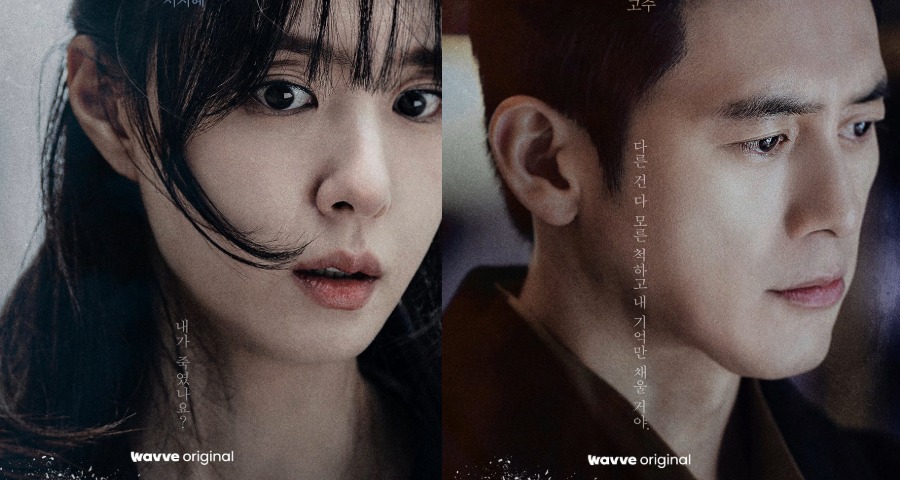
Reverse (2026)
리버스 (Ribeoseu)
Genre: Thriller, Mystery, Melodrama
Screenwriter & Director: Lim Gun Joong
Few dramas embrace uncertainty as fearlessly as Reverse.
Rather than functioning as a conventional mystery focused purely on uncovering answers, Reverse unfolds as a psychological noir built upon fractured memories, emotional distortions, and unstable perceptions. It is not a drama interested in offering easy truths. Instead, it constantly challenges what viewers think they understand, pulling them deeper into a maze where trauma, guilt, desire, and revenge blur every boundary between truth and illusion.
Through intricate storytelling and relentless reversals, Reverse transforms itself into one of the most psychologically demanding Korean dramas of 2026.
At only eight episodes long, the series wastes little time establishing its disorienting atmosphere. Yet despite its short runtime, it consistently overturns assumptions, refusing to allow viewers the comfort of certainty.
Plot: Memory as a Dangerous Illusion
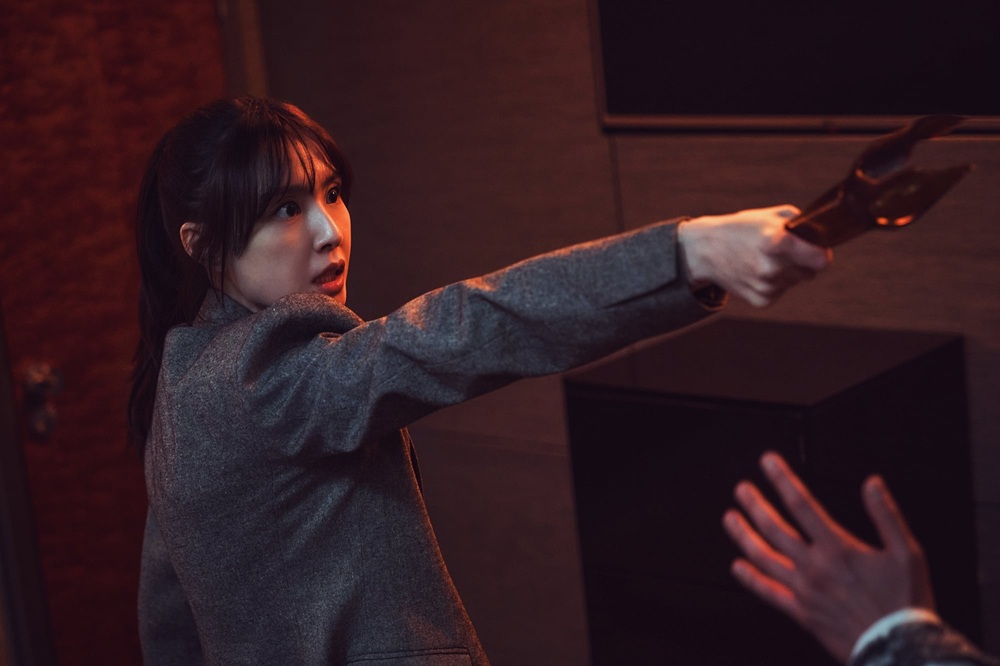
Ham Myo Jin (Seo Ji Hye) lost her parents in a mysterious accident during childhood. For fifteen years, she has lived with only one purpose: revenge.
When what appears to be the perfect opportunity finally arrives, everything changes.
Myo Jin becomes involved in a devastating car accident and loses all of her memories.
As she attempts to recover fragments of her forgotten past, new truths gradually emerge, forcing her to confront disturbing revelations hidden beneath memory loss, deception, and long buried trauma. Every recovered memory seems to create more questions than answers, pulling her closer toward a shocking truth that changes everything she thought she knew.
The story begins after Myo Jin escapes from a villa moments before it explodes. In the chaos, she loses control of her car and is violently struck by a truck, barely surviving the accident.
When she awakens in hospital, she appears to suffer from partial amnesia. Much of her memory has vanished, including recognition of the people closest to her, particularly her fiancé, Ryu Jun Ho (Go Soo), a successful internationally renowned architect who assumes the role of caretaker during her recovery.
Meanwhile, police investigate the villa explosion that killed two people, including Myo Jin’s close friend Choi Hui Su (Kim Jae Kyung) and her influential father.
As the investigation deepens, new figures emerge: a mysterious blackmailer tied to Jun Ho, a Chinese gang with unclear motives, and the enigmatic Ki Cheol (Yoon Je Moon), whose involvement appears strangely intertwined with Myo Jin’s buried past.
However, Reverse quickly establishes that nothing is as simple as it first appears.
Every truth hides another deception.
Every revelation conceals another performance.
And every recovered memory raises more suspicion than certainty.
Narrative Structure: Confusion as Design
One of Reverse’s greatest strengths, and perhaps its greatest challenge, lies in its narrative construction.
Built through fragmented timelines, flashbacks, omissions, sensory recollections, and shifting perspectives, the drama intentionally destabilizes perception. Past and present collapse into each other, memories become unreliable, and viewers are forced to constantly question whether what they are seeing is reality, hallucination, manipulation, or selective recollection.
This fragmentation serves a purpose far beyond suspense.
Rather than simply creating mystery, Reverse immerses viewers inside fractured consciousness itself.
The drama transforms memory into performance, suggesting that recollection is not necessarily truth, but something reshaped by trauma, guilt, and desire.
At its strongest, this approach is remarkably effective. Every episode recontextualizes earlier events, forcing previous assumptions to be reconsidered. The constant reversals create an atmosphere where moral certainty becomes impossible and no stable point of reference truly exists.
However, the ambition occasionally comes at a cost.
Episodes four and five, in particular, risk becoming overly convoluted. Although color grading attempts to differentiate timelines, the lack of consistent temporal markers occasionally makes it difficult to distinguish between memory, hallucination, and reality. At times, the experience shifts from intriguing disorientation to genuine confusion.
The result is a drama that sometimes demands analytical effort rather than emotional immersion.
For some viewers, this cerebral complexity will feel rewarding.
For others, frustrating.
Beyond the Thriller: Trauma, Privilege, and Moral Corruption
Beneath its mystery structure, Reverse reveals itself to be something far more psychologically unsettling.
The drama repeatedly refuses simplistic moral binaries, instead forcing viewers to question who deserves sympathy and who deserves blame.
Victims gradually resemble perpetrators.
Perpetrators reveal moments of vulnerability.
Truth itself becomes morally unstable.
One of the drama’s most fascinating undercurrents is its critique of class privilege and emotional exploitation. Through the character of Hee Su, Reverse explores how suffering can be transformed into aesthetic performance, and how privilege allows certain individuals to reshape guilt into sensitivity, artistry, or moral legitimacy.
Trauma becomes currency.
Pain becomes performance.
Even art itself feels implicated in the drama’s moral ambiguity.
Recurring fire imagery reinforces this psychological instability. Fire appears throughout the series as primal trauma, sensory memory, and symbolic repetition, repeatedly dragging characters back toward unresolved violence, guilt, and self destruction.
Every flame feels less like destruction and more like memory refusing to disappear.
Performances That Carry the Emotional Weight
Within such an unstable emotional landscape, the cast becomes essential.
Because the drama asks its characters to exist in perpetual ambiguity, the performances must constantly balance sincerity with manipulation.
Seo Ji Hye delivers perhaps the strongest performance of the series as Ham Myo Jin.
Her portrayal remains elusive from beginning to end, balancing fragility, intelligence, pain, and quiet calculation through remarkably restrained acting. Small glances, hesitations, and subtle facial shifts become impossible to interpret with certainty, transforming Myo Jin herself into an emotional puzzle that constantly invites reinterpretation.
Go Soo, meanwhile, delivers a quietly unsettling performance as Ryu Jun Ho.
Initially appearing dependable and reassuring, Jun Ho gradually begins to evoke classic psychological noir archetypes. His emotional manipulation, elegant charm, and subtle cruelty increasingly transform his relationship with Myo Jin into something disturbingly reminiscent of a perceptual prison, where care and control become nearly indistinguishable.
Kim Jae Kyung leaves a strong impression as Choi Hui Su, whose presence lingers over much of the emotional and psychological conflict despite the mystery surrounding her fate.
Yoon Je Moon also delivers a memorable performance as Ki Cheol, embodying a melancholic figure weighed down by guilt, mortality, and emotional exhaustion.
Even secondary criminals bring an oddly grotesque energy to the series, balancing menace with absurdity in ways that occasionally recall dark noir black comedy.
Cast
Seo Ji Hye as Ham Myo Jin
Go Soo as Ryu Jun Ho
Kim Jae Kyung as Choi Hui Su
The Finale: No Comfort, No Easy Truths
Reverse ultimately reveals its true intentions through its ending.
Rather than resolving ambiguity through comforting explanations or moral closure, the series refuses easy reconciliation.
Truth does not heal.
Revenge does not liberate.
Memory does not restore balance.
Instead, every revelation further contaminates what seemed previously understood, creating a finale that feels tragic, chilling, and emotionally unstable.
One of the drama’s smartest decisions lies in its use of the psychiatrist during the final stretch. Much like viewers themselves, the psychiatrist is forced to reconsider every gesture, hesitation, and statement retroactively, only realizing too late how deeply perception has been manipulated.
The ending becomes devastating precisely because it resists catharsis.
The “gift” referenced near the conclusion evolves into something deeply unsettling, suggesting not salvation, but the recognition of shared darkness and emotional ruin.
Perhaps Reverse’s most radical idea is that truth does not always exist to heal.
Sometimes truth merely exposes how deeply trauma, revenge, and desire have already transformed a person beyond repair.
Final Thoughts
Reverse is not an easy drama.
It is demanding, occasionally frustrating, deliberately disorienting, and unapologetically cerebral.
Its middle stretch sometimes loses clarity beneath excessive narrative entanglement, and certain plot elements feel unnecessarily complicated. Yet when the drama finally reveals its hand, especially in its final episodes, the payoff proves remarkably compelling.
This is a psychological puzzle that rewards patience.
Dark, unsettling, morally ambiguous, and intellectually challenging, Reverse refuses to separate heroes from villains or victims from perpetrators. Instead, it presents human nature as something unstable, contradictory, and often disturbingly self deceptive.
While imperfect, Reverse remains one of the boldest thriller experiments of 2026, a fascinating exploration of memory, manipulation, and the darkness hidden beneath human consciousness.
Rating: 8.5/10. Imperfect, frustrating at times, but deeply compelling and psychologically unforgettable.